On being seen:
I remember Dad hated when people would stare at us when we went out into the city.
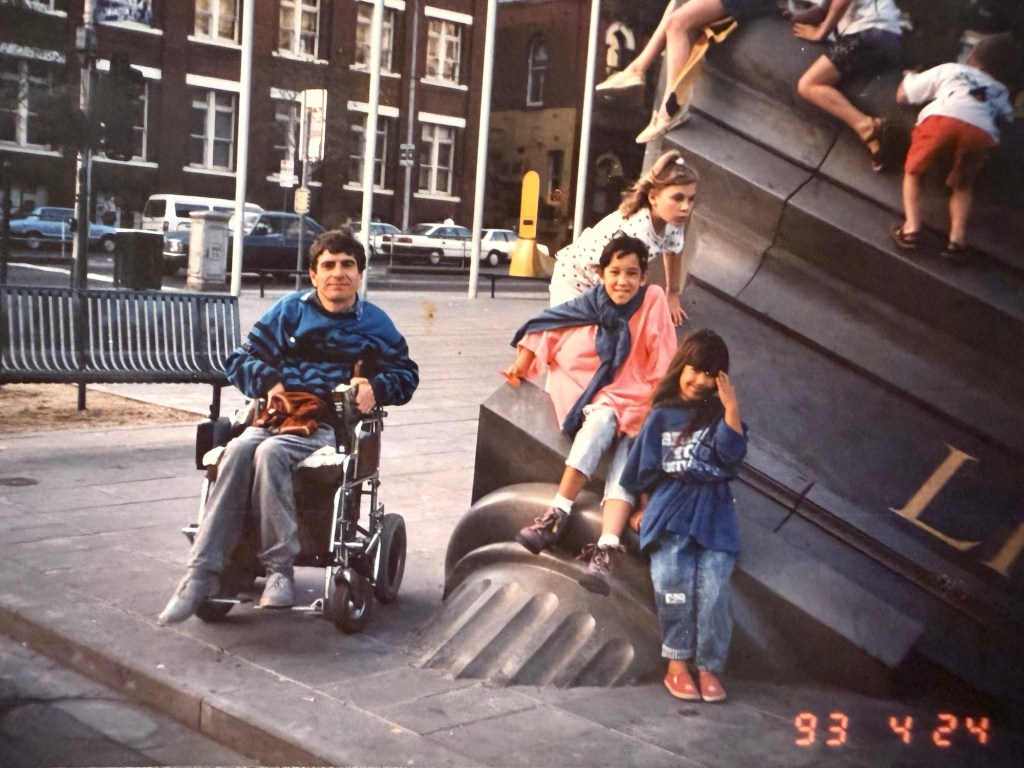
I was painfully shy, I would stand next to him with big eyes and stare back at them. He’d tell me to ignore them and huffily zoom off, usually with me riding on the back of his chair.
I suppose I’d never really thought about what it would have been like to be a teenager in a small town, suddenly with a wheelchair. How you would have been so weird. So different. Dad wrote:
(1966-1968)
“Having retained an indelible memory of my first outing in a wheelchair to the Picture Theatre, I resisted all the family’s attempts to encourage me to leave the house.
As I had done on my two stints of leave from PA, when a street parade was held, I accompanied them on the condition that I observed it from the darkened showroom of the Grazcos office. This was better than being
exposed to view on the footpath.
Although I was reluctant to join the community, it came to me in the form of Ian’s friends, who regarded our home as a gathering place. They were enjoying their end-of-year school holiday, which they devoted to playing with Ian’s model electric train set that had taken over the living
room floor.
I was relieved that they accepted me into this scene, even contriving ways that I could twist the knobs of the speed control box that delivered power to the track.
Lenny Horne was the most regular visitor, as he had been throughout my seven-month stay at the Charleville Base Hospital.
Although he joined in the train set fun, he enjoyed his contact with the whole family. He especially loved the attention Mum lavished upon him and the meals in which
she included him. He was so comfortable that he called her ‘Mum’.
Lenny was still full of laughter, jokes and exaggerated tales of the mischief in which he
constantly found himself. A typical visit from him involved waiting for Mum to disappear so he could extract his cigarettes from under my bed frame and enjoy one. Although we both suspected Mum was aware of his intentions, she seemed content to condone them. After all, she knew that Lenny’s time with me was vital, certainly to me and perhaps himself seeing he was often more
disposed to sleeping on a spare mattress on the Kidd floor than to going home.
When it came time for Lenny to leave, he usually said, “Be back in a few minutes.” His few minutes sometimes represented days, weeks and even months but Lenny always came back. Even though our personalities and interests were different, his fun-loving companionship was very important to me.
It became particularly important when in early 1967 Kingsholme rejected my
referral on the assumption that I was unemployable. Lenny continued visiting throughout this year, his final one of high school. (And afterwards during the period in which he worked as a postman before joining the exodus of young people seeking adventure elsewhere, only returning for an occasional stay with his family.)”
 GregKidd
Leave a comment